MILAGPT Blog
MILAGPT Blog
How Mila did it, project news and tips for your business — short, with numbers and examples. Most articles are in Russian for now.
Case studies — how Mila did itNews — what's new with the MilasTips — tricks for your business
 NewsThe new milagpt.io: Milas work — so people can liveWe rebuilt milagpt.io: the home page now shows which Milas there are, what they can do today and how to get your own — free for 3 days.Read →
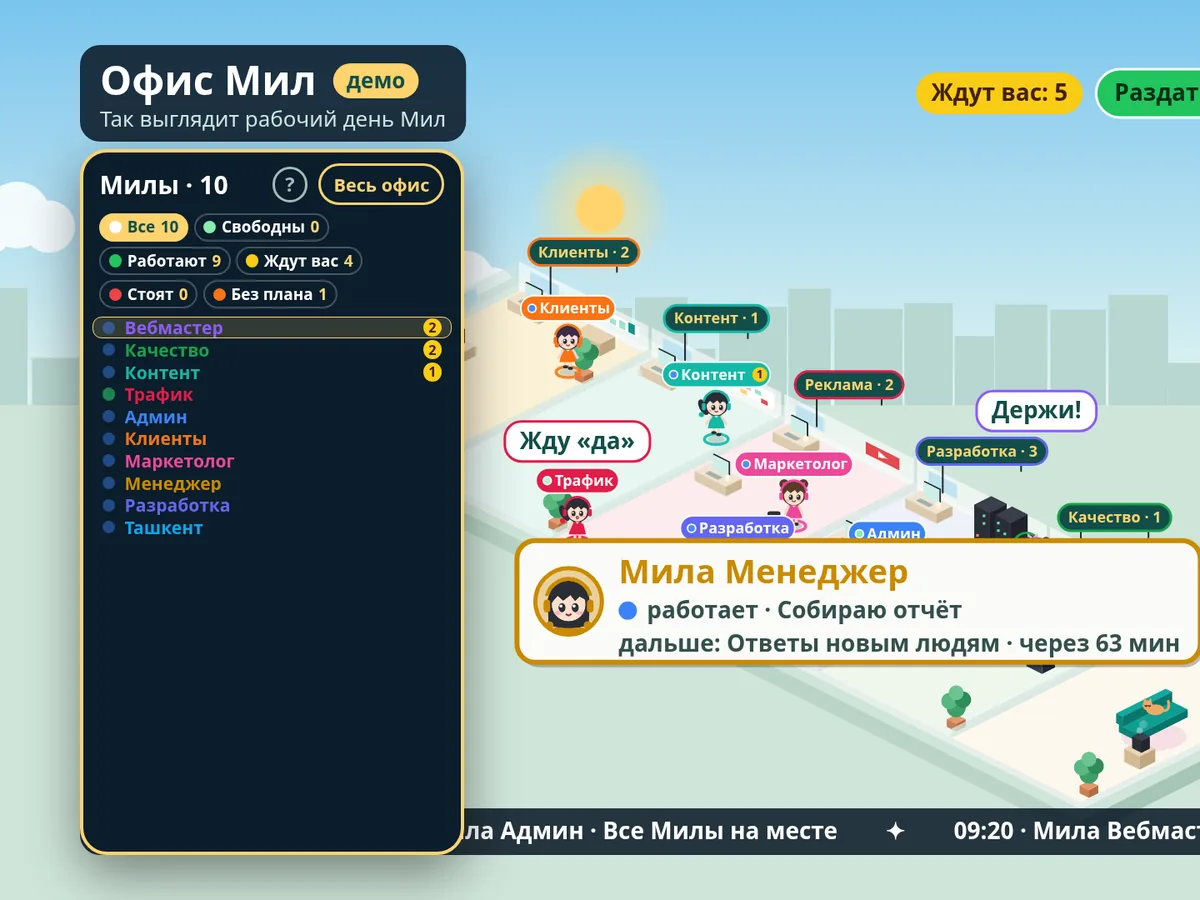 NewsMila Office: the Mila team on screenMila Office is a live screen that shows what each of our Milas is doing right now, what she has done today and who has nothing next. Tasks are handed out right from the screen.Read →
 Case studyHow a Mila is bornFrom the first chat to the first lesson: how a person gets their own Mila — with a name, a memory of their business and a first skill.Read →
 Case studyWhat intelligence costs — three years of numbers and our own billFlagship models got 15 times cheaper in three years, workhorse models 750 times. We use our own numbers to show what we really pay for.Read →
 NewsSince September 1, Tashkent has a newspaper run by AITashkent Today: two issues a day in three languages, a city map and a notice board. Editor-in-chief: Mila Tashkent.Read →
Ideas4 stages of adopting AI — and where yours got stuckThe AI adoption ladder from "locked away" to AI-native — in our own words, with MILAGPT examples.Read →
Case studyThe Telegram bot factory: the quiet BotFather revolutionA bot used to need code, a server and a developer. Now one click creates a specialist agent. Here is how we do it.Read →
Case studyThe content factory: how AI runs newspapers for whole citiesAI agents run city newspapers on their own: every night they collect, sort and publish. How it works inside.Read →
IdeasThe robot will go on stage, not to the factoryOur founder's forecast: the most valuable use of humanoid robots is art, not cheap labour. Robot artists, robot celebrities.Read →
IdeasA cooperative by analogy: lessons from Soviet housing co-opsHow people in the USSR built their own homes without a developer — and why the MILAGPT cooperative follows the same logic.Read →
TipsThe Anthropic prompt library — now in Russian52 ready-made prompts for Claude and Claude Code in natural Russian. How to use them.Read →
IdeasBattle of ecosystems: how 140 corporations are rewriting moneyVisa, Mastercard, BlackRock, Coinbase and Stripe launched a stablecoin that shares its income with network members.Read →
IdeasFive archetypes of the futureInstead of product managers, engineers and designers — five roles that do not depend on a profession. One person covers up to three.Read →
Ideas"Robots do the grind" — why this is our sloganWhere the line from a 1979 film comes from and what the Russian verb "vkalyvat" really means.Read →
IdeasThe third UX redesign: software comes aliveThree waves of interfaces — and why the MILAGPT nanobot factory makes the new wave available to everyone.Read →
IdeasThe cooperatives that quietly run the worldA billion co-owners and 10% of the world's jobs. Banks, factories, farms and clubs owned by ordinary people.Read →
Case studyWhy build your own LLM — and how we made a prototype for $15Who needs their own models and when, what fine-tuning costs — and our experience building MILA LLM.Read →
Case studyHow MILAGPT saves 90% on AI tokensA real story: from $100 a month to $10–15 without losing quality. Seven tricks that cut the bill.Read →
Case studySecond Brain — a module for capturing thoughtsTalk in Telegram — get ready tasks and sorted ideas.Read →
Tips50 tips for Claude CodeA free guide: from the first launch to agents working in parallel.Read →
TipsOpenClaw: cutting costs by 80%Six steps, ready settings and numbers: from $100–300 down to $10–30 a month.Read →
TipsA second brain: Claude Code instead of ChatGPTLocal project memory, your own skills and context instead of prompts.Read →
NewsSince September 1, Tashkent has a newspaper run by AITashkent Today: two issues a day in three languages, a city map and a notice board. Editor-in-chief: Mila Tashkent.Read →
Ideas4 stages of adopting AI — and where yours got stuckThe AI adoption ladder from "locked away" to AI-native — in our own words, with MILAGPT examples.Read →
Case studyThe Telegram bot factory: the quiet BotFather revolutionA bot used to need code, a server and a developer. Now one click creates a specialist agent. Here is how we do it.Read →
Case studyThe content factory: how AI runs newspapers for whole citiesAI agents run city newspapers on their own: every night they collect, sort and publish. How it works inside.Read →
IdeasThe robot will go on stage, not to the factoryOur founder's forecast: the most valuable use of humanoid robots is art, not cheap labour. Robot artists, robot celebrities.Read →
IdeasA cooperative by analogy: lessons from Soviet housing co-opsHow people in the USSR built their own homes without a developer — and why the MILAGPT cooperative follows the same logic.Read →
TipsThe Anthropic prompt library — now in Russian52 ready-made prompts for Claude and Claude Code in natural Russian. How to use them.Read →
IdeasBattle of ecosystems: how 140 corporations are rewriting moneyVisa, Mastercard, BlackRock, Coinbase and Stripe launched a stablecoin that shares its income with network members.Read →
IdeasFive archetypes of the futureInstead of product managers, engineers and designers — five roles that do not depend on a profession. One person covers up to three.Read →
Ideas"Robots do the grind" — why this is our sloganWhere the line from a 1979 film comes from and what the Russian verb "vkalyvat" really means.Read →
IdeasThe third UX redesign: software comes aliveThree waves of interfaces — and why the MILAGPT nanobot factory makes the new wave available to everyone.Read →
IdeasThe cooperatives that quietly run the worldA billion co-owners and 10% of the world's jobs. Banks, factories, farms and clubs owned by ordinary people.Read →
Case studyWhy build your own LLM — and how we made a prototype for $15Who needs their own models and when, what fine-tuning costs — and our experience building MILA LLM.Read →
Case studyHow MILAGPT saves 90% on AI tokensA real story: from $100 a month to $10–15 without losing quality. Seven tricks that cut the bill.Read →
Case studySecond Brain — a module for capturing thoughtsTalk in Telegram — get ready tasks and sorted ideas.Read →
Tips50 tips for Claude CodeA free guide: from the first launch to agents working in parallel.Read →
TipsOpenClaw: cutting costs by 80%Six steps, ready settings and numbers: from $100–300 down to $10–30 a month.Read →
TipsA second brain: Claude Code instead of ChatGPTLocal project memory, your own skills and context instead of prompts.Read →
Nothing here yet — check "All".
Subscribe — new posts come to you
New case studies, news and tips — in the MILAGPT Telegram channel (in Russian).